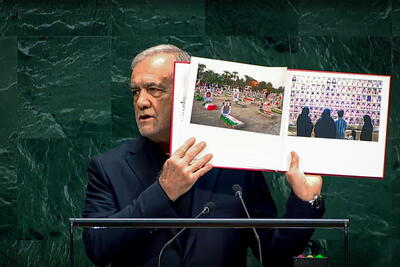
1- The United Nations General Assembly
The annual session of the United Nations General Assembly began on Tuesday, September 22, 2026. Some heads of state, including the leaders of China, Russia, and India, are not attending this year’s session. Nevertheless, the war between the United States and Iran, the reopening of the Strait of Hormuz, and the presence of Donald Trump and Masoud Pezeshkian, the presidents of the United States and Iran, respectively, have attracted considerable international attention.
Regardless of what the two presidents said in their speeches, the United States’ renewed declaration of ist readiness to engage in talks with Iran—and the Iranian side’s undeclared willingness to negotiate, albeit on the sidelines of the General Assembly—are among the important issues surrounding this year’s session.
In his address to the UN General Assembly, Trump once again spoke of the possibility of reaching an agreement with Iran, while also threatening military action, including his warning that Iran could be “sent to hell.” Why Trump is once again threatening Iran, and how realistic the possibility of these threats being carried out actually is, are questions that merit serious consideration. Trump’s interest in dialogue has reportedly been conveyed to Iran through Steve Witkoff, via Pakistan and Qatar.
A day after Trump’s speech, Iranian President Masoud Pezeshkian, referring to what he described as U.S. and Israeli crimes in the attack on Iran and the killing of people in Gaza, emphasized: “Iran is ready for dialogue based on equality, but it will never understand the language of force.” Addressing Iran’s neighboring countries in the region, he said: “No one in this region will have security on their own. Either we will build security together, or we will all endure insecurity together.”
At the conclusion of his speech, responding to Trump’s reference to the possibility of dialogue, the Iranian president again stressed: “Iran is ready for dialogue based on equality, but it will never understand the language of force.”
Meanwhile, Iranian Foreign Minister Abbas Araghchi, who traveled to New York alongside Pezeshkian, has held meetings with several European leaders, including the EU foreign-policy chief, as well as the Italian prime minister and foreign minister and the German foreign minister, who sought talks with the Iranian representative.
There is little doubt that the central issues in these meetings are economic matters, and specifically the reopening of the Strait of Hormuz. At the same time, experience has shown that European officials occasionally raise the issue of human rights violations in Iran during such meetings. Denying the issue or removing it from the agenda does not help build mutual trust. We should also remember that diplomacy is, by ist nature, a bilateral or multilateral process, and Iran itself needs European cooperation and support.
2- Sanctions and the Economic Dimension
At the same time, we must bear in mind that the crippling—or, as some might describe it, “crushing”—sanctions are being pursued aggressively by the U.S. Treasury Department.
The scope of these sanctions has reportedly extended to the closure of Bank Mellat in Turkey, restrictions preventing flights bound for Iran from refueling at airports, and even threats against China because of the scale of ist trade and economic exchanges with Iran.
Perhaps it is against this backdrop that one can understand China’s recent requests to Abbas Araghchi, during his latest visit to the country, that the Strait of Hormuz must be reopened. This is taking place even as China, together with Russia, vetoed a UN Security Council resolution against Iran.
Political support and international solidarity with Iran—yes; economic sanctions because of Iran—no.
3- Yemen, the Bab el-Mandeb, and Regional Realignments
The recent victories of the Houthis in the Bab el-Mandeb region, their control over several strategic ports and islands, and the attack on the Saudi oil pipeline leading to the Red Sea have also had significant effects on the global economy and international politics. They represent a new challenge for the United States, Israel, and their allies, and have become an important regional issue.
Although the Houthis are often described as proxies of the Islamic Republic and as part of the so-called “Axis of Resistance,” some observers do not consider the crisis in the Bab el-Mandeb and Yemen entirely unrelated to the rivalry between Saudi Arabia and the United Arab Emirates. They have cited various indications that recent developments in the Bab el-Mandeb may mark the beginning of a new military-security alignment in the region.
What is certain is that Yemen’s current position is advantageous to the Islamic Republic and has increased ist significance in the region, to the extent that Saudi Arabia has asked Iran to engage in dialogue with the Houthis.
It is important to note that this request comes at a time when Saudi Arabia has maintained a military cooperation agreement with Pakistan for years and has recently concluded the so-called “Mecca Pact” with Pakistan and Turkey.
The implications of this agreement deserve consideration in their own right. But the central point is the apparent ineffectiveness of such an arrangement in preserving security and Saudi Arabia’s resulting need to turn to the Islamic Republic.
Conclusion
The picture presented above clearly demonstrates the importance and role of diplomacy compared with war and military threats. A look at the Shanghai Cooperation Organization, BRICS, and the United Nations General Assembly highlights the central importance of security and economic considerations.
Iran’s participation in international summits is particularly significant at a time when the country is struggling under the weight of severe sanctions. But the central question remains: How, and by what means, can Iran navigate these difficult and dangerous circumstances in a way that safeguards the country’s security and national interests?
There is no doubt that any effort aimed at opposing war and preventing the outbreak of a new war against Iran would serve this objective. At the same time, however, there is a worrying possibility that the Islamic Republic could become overconfident because of the balance that has emerged in the region in ist favor, and once again squander opportunities.
However valid the idea that “no one in the region can achieve security alone” may be, it cannot justify the proposition that “we should share our insecurity with others.”
Ensuring security and providing citizens with a dignified life are the duty and responsibility of every government. Unfortunately, however, the Islamic Republic has, through what can be described as ist adventurist policies, repeatedly placed the fate of the country and ist people at risk and exposed them to threats and danger.
 چاپ
چاپ
Add new comment