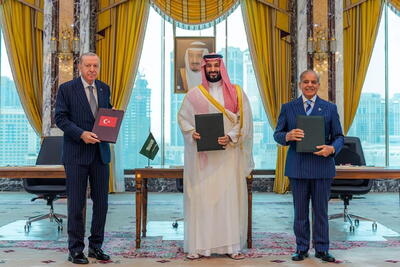
On 7th August 2026 a defence pact was signed between Saudi Arabia, Pakistan and Turkey in Mecca. Similar to the NATO pact, it declares that any attack against one signatory will be considered an attack on all three. What is the significance of this agreement?
It is said that the negotiations to achieve this pact took two years. Egypt, too, participated in these negotiations but has offered no explanation for why it declined to sign the final document.
Each of the three signatories brings unique strengths to this pact. Turkey possesses the second largest military in NATO and has a strong military industrial base, especially in drone technology. Pakistan is the nuclear armed power of the trio while Saudi Arabia is its cash-rich member.
It is a matter of speculation in some quarters whether this pact can develop into the kind of single coordinated military force embodied by NATO. But the reader should be aware that, for years, thousands of Pakistani soldiers have been training the Saudi military and one squadron of Pakistani jets (Chinese-manufactured) are stationed in Saudi Arabia. There are also thousands of Turkish forces in Qatar
There are plans to hold joint military exercises, though details haven’t been made public. The pact appears to be a work in progress.
Its key significance seems to be its long-term political ramifications. This pact has been signed in the midst of the US/Israeli war against Iran. Does it imply a gradual disengagement of the US from the Middle East, with this agreement a key element of what might fill the vacuum?
A strategic “pivot to Asia” remains the US administration’s top international priority, focused upon confronting China.
Meanwhile, the Arab Gulf states are not happy with the ongoing outcome of US efforts in defending Arab lands against Iranian missiles and drones, compared with American efforts in defending Israel. The Arab governments were told the US bases will defend them. In fact these countries have been targeted exactly because of those – very expensive – bases.
The Middle East is evolving. New actors will appear on the scene. Prominent US strategic initiatives, such as the Abrahim Accord “peace plan”, will be sidelined together with some current actors, such as the UAE. Meanwhile, other countries further afield, such as India, are already concerned about the ramifications of this pact.
Beyond the combined weight of the three pact signatories, there are two main regional powers in the Middle East: Israel and Iran. While much depends upon the outcome of the current US/Iran war, a 3-way political power struggle between pact members, Israel and Iran is likely. Given Israel’s posture towards Turkey, especially over Syria, and its genocidal aggression, there is significant scope for regional dynamics to develop into a struggle for peace in the Middle East vs Israeli expansionism.
 چاپ
چاپ
Add new comment